Lithuania and the Fracturing Politics of Critical Minerals
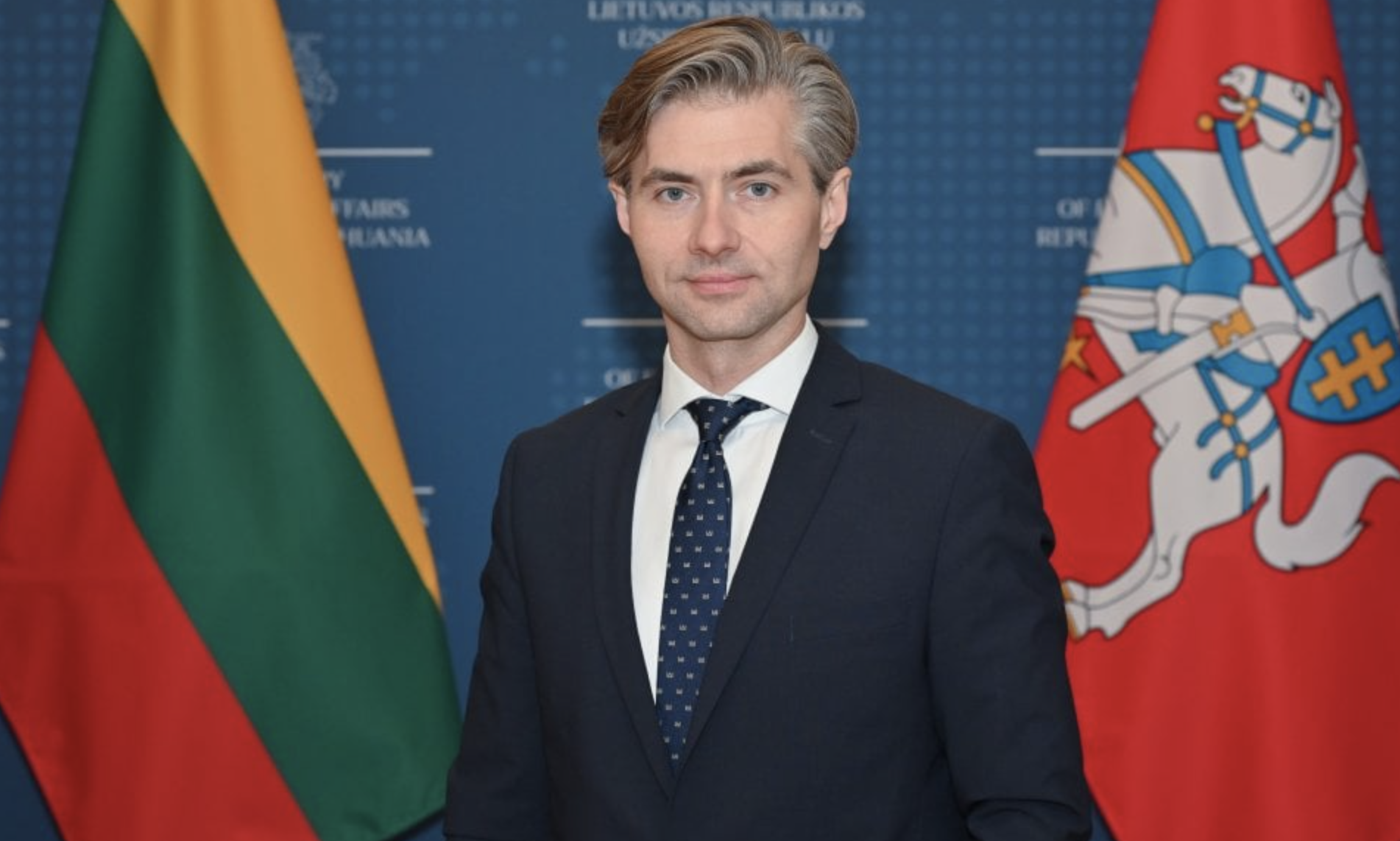
Kęstutis Budrys. Lithuania. Minister for Foreign Affairs. Attribution CC BY 3.0: LRT
A Move for Strategic Autonomy, or Strategic Urgency?
⟁ OPINION | Arno Saffran, Mon 16 Feb, 2026In todays every changing geopolitical economy, critical minerals are no longer a trade sidebar. They are infrastructure for sovereignty. We see this clearly with recent signals from Vilnius suggesting that Lithuania may pursue a bilateral critical minerals arrangement with the United States if an EU-wide agreement does not advance quickly enough.
Foreign Minister Kestutis Budrys has made it clear that Lithuania may sign a minerals deal with the USif European negotiations proceed too slowly, positioning bilateral negotiations as necessity rather than preference, driven by temporal constraints rather than ideological positioning.
Lithuania's Foreign Minister recently attended the Critical Minerals Ministerial hosted by the United States and US Secretary of State Marco Rubio with a timely and important platform bringing together more than 50 nations to advance collective action on resilient critical minerals supply chains.
What I think this means that, if realised, it would mark a notable moment: an EU member state stepping outside the bloc framework to secure supply in an area increasingly defined by security logic rather than commercial convenience.
For a frontline NATO state, this is not rhetorical positioning. It is risk management, and in protecting their economic interests first, perhaps understandable? Yet it does make a dangerous advent (yet another) as a blow to EU stability.
Critical Minerals as Defence Infrastructure
Such a move serves to outline just hm important these elements are to individual countries, with rare earth magnets, lithium, gallium, germanium and associated battery metals the foundational inputs into:
Advanced electronics
Defence systems and precision weaponry
Electric mobility platforms
Grid and storage technologies
Semiconductor manufacturing
While mining capacity is geographically dispersed, its important to understand that the processing and refining are far more concentrated. In several critical supply chains, China maintains a dominant position in downstream processing — the stage where technical leverage and export controls exert maximum influence.
Beijing’s tightening of export controls on certain strategic minerals over the past year has reinforced a simple lesson for policymakers across Europe: processing capacity equals strategic power.
Why Lithuania Is Moving
Lithuania’s economy is small but highly integrated into engineering, high-tech manufacturing and defence value chains. Its security posture — shaped by geography and history — places resilience at the centre of industrial planning.
Vilnius’ calculation appears straightforward:
The EU’s collective approach to critical minerals is comprehensive but procedurally slow.
Industrial vulnerability is immediate.
The United States is actively constructing alternative supply networks among aligned economies.
If Brussels cannot operationalise agreements at speed, Lithuania may seek to plug directly into U.S.-aligned supply chains — whether through sourcing arrangements, joint ventures in third countries, or collaboration in refining and recycling capacity.
For Eastern European states with acute security sensitivities, the timeline matters as much as the policy architecture.
The Brussels Dilemma
The European Commission has consistently preferred coordinated, reciprocal, bloc-level frameworks over bilateral side deals. The logic is clear: fragmentation weakens collective bargaining power and complicates trade coherence.
Yet the EU’s strength — consensus among 27 member states — can also be its constraint.
Critical minerals policy now sits at the intersection of trade, climate, defence and industrial competitiveness. Aligning those priorities across multiple capitals inevitably slows execution.
If Lithuania were to proceed independently, it could establish a precedent. Other security-focused member states might reassess the balance between collective solidarity and national urgency.
The risk is not immediate rupture — but incremental divergence.
Washington’s Strategic Calculus
The United States has been explicit in its objective: reduce exposure to Chinese processing dominance by constructing resilient supply chains with trusted partners.
Bilateral arrangements fit that strategy neatly.
Direct partnerships allow Washington to move faster, tailor cooperation, and integrate allies into broader industrial frameworks spanning defence production, battery manufacturing and advanced materials.
From this vantage point, Lithuania’s overtures are less an anomaly and more a reflection of a broader reconfiguration: critical minerals diplomacy is becoming modular rather than monolithic.
The Bigger Picture with Industrial Policy as Security Policy
The underlying reality is unambiguous. Critical minerals policy is now defence policy by another name. Control over rare earth separation, battery precursor production, gallium refining or germanium processing shapes the resilience of:
Weapons systems
Renewable infrastructure
Semiconductor supply
Automotive electrification
Communications networks
In this environment, speed, diversification and allied integration carry strategic weight. Lithuania’s signalling is therefore less about breaking ranks and more about accelerating alignment.
Fragmentation or Flexibility?
The coming months will test whether the EU can match geopolitical urgency with procedural agility. A credible, timely bloc-level agreement would reinforce cohesion and strengthen Europe’s negotiating leverage globally. If not, smaller states may continue to hedge.
The energy transition and the security transition are converging. Industrial policy can no longer be compartmentalised from geopolitics. For Lithuania — and increasingly for others — certainty of supply is not an economic preference. It is a national imperative. And in the era of strategic competition, minerals are no longer commodities. They are instruments of statecraft.
References:
How relevant and useful is this article for you?
★ 9
UNAMINE works across the mining & metals value chain, positioning people who form the critical bridge to early-stage relationships in complex regions.