Artisanal Mining's $15B Promise
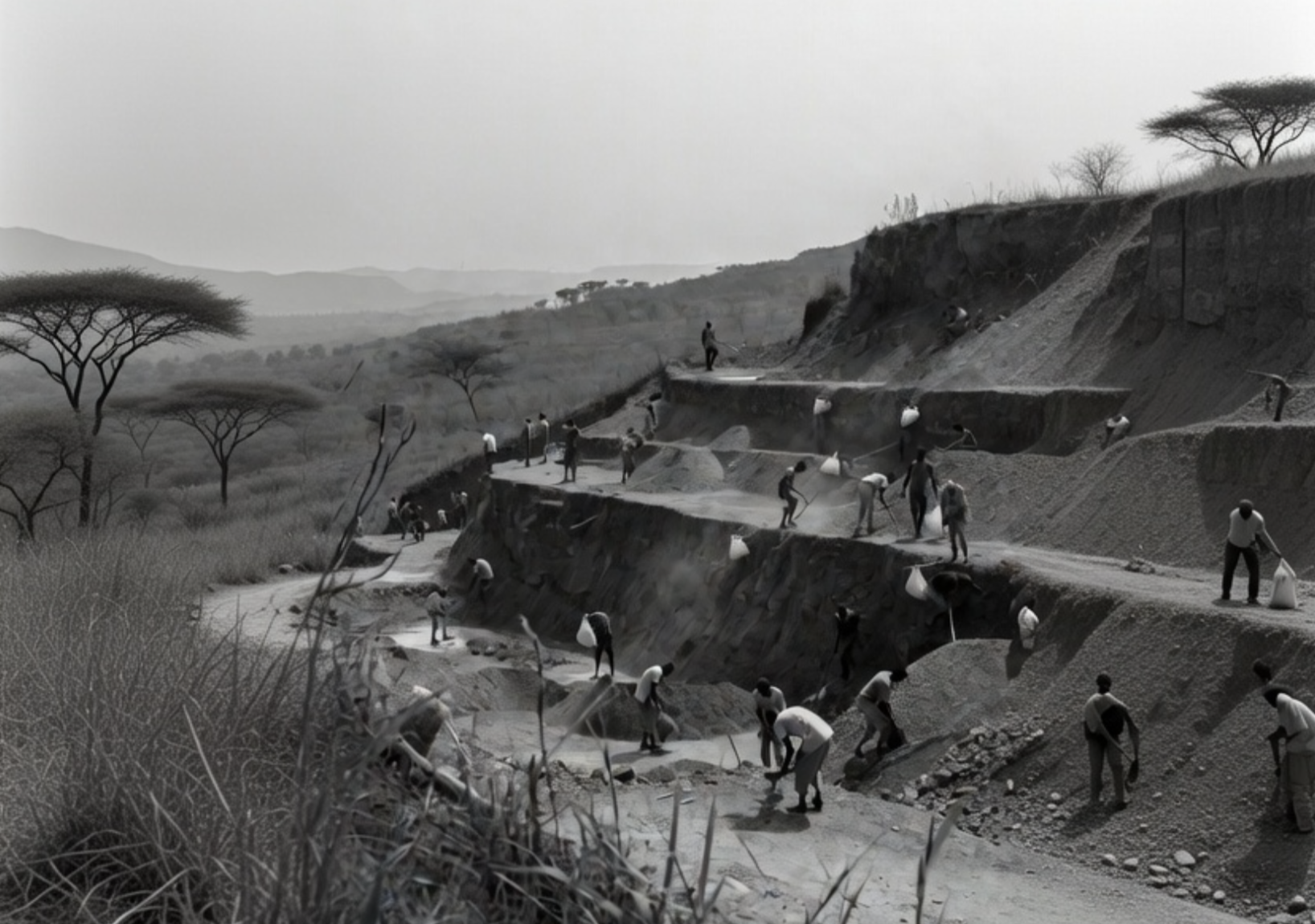
Turning Artisanal Miners into Economic Partners. Image: HB Media
Why Artisanal Mining Is Africa's Most Undervalued Asset
⟁ OPINION | Arno Saffran, Tue 18 Nov, 2026For decades, the extractive industry has viewed artisanal and small-scale mining through a singular lens: risk. The informal digger is cast as trespasser, the unlicensed operation as threat, the absence of paperwork as evidence of criminality. This perspective, while understandable given the real security challenges that accompany unregulated activity, has become an obstacle to clear thinking about one of the most persistent features of Africa's mineral landscape.
The numbers demand a different approach. Worldwide, nearly 45 million people are directly employed in artisanal and small-scale mining, with up to 315 million people depending on the sector indirectly . In Africa alone, approximately 10 million artisanal miners operate across the continent, with an estimated 2–3 million in the Democratic Republic of Congo . The sector now produces nearly 20% of the world's gold—a dramatic increase from just 4% in the 1990s—and at least 12% of global cobalt .
The question is not whether artisanal mining will exist. It will. The question is whether formal operators, investors, and governments will engage with it constructively or continue to treat it as a problem to be contained.
The Economic Logic of Informality
Understanding artisanal mining requires first understanding the arithmetic that drives it. A 2024 analysis confirms that approximately 70–80% of ASM operations across sub-Saharan Africa remain informal or illegal, despite decades of formalisation efforts . In South Africa, where an illegal miner can earn dramatically more than formal sector wages, the incentive structure remains clear. At current gold prices exceeding $4,800 per ounce in early 2026, the premium on informality is simply too high for enforcement alone to overcome.
This is not merely a matter of criminal greed. Research increasingly demonstrates that many artisanal miners would prefer legal status if it were attainable. However, formalisation policies have often adopted "generic frameworks, failing to consider the sector's diversity and local realities".
The barriers are structural: cumbersome licensing processes, institutionalised corruption, and prohibitive upfront costs that exclude precisely those whom formalization purports to serve.
A recent academic study identifies five categories of barriers perpetuating informality: the absence of formalization frameworks, inappropriate frameworks that fail to align with sector realities, weak enforcement compounded by corruption, exclusionary policies with costly requirements, and broader structural challenges including limited access to finance and markets . These factors collectively ensure that the choice between informality and formalisation, for many miners, is not a choice at all.
Distinguishing the Actors
Not all artisanal mining is alike, and treating it as a unitary phenomenon guarantees policy failure. Contemporary scholarship emphasises the need for "differentiated licensing regimes" that recognise the heterogeneity of ASM operations . A useful distinction can be drawn between three categories of actors.
First are community-based informal miners who operate with local legitimacy even in the absence of state sanction. They are often organised by traditional authorities, follow customary rules, and view themselves—with some justification—as exercising rights that predate the modern state. Their mining may be technically illegal, but it is socially embedded and economically essential.
Second are formalisation-ready operators who would transition to legality under the right conditions. These include artisanal miners who have accumulated some capital, developed basic organisational capacity, and recognised the limitations that informality imposes—inability to access credit, vulnerability to exploitation by buyers, exclusion from higher-value markets.
Third are criminal actors who operate mining sites for profit, often with links to armed groups, smuggling networks, or corrupt officials. These operations are characterised by violence, exploitation, and the absence of any community accountability. They require a security response proportionate to the threat they pose.
The critical failure of current approaches is the tendency to treat all three categories identically. When community-based miners are met with armed security and criminal prosecution, they become radicalised. When formalisation-ready operators find no pathway to legality, they remain in the informal economy. When criminal actors face no effective enforcement, they expand their control.
The Formalisation Imperative
The 2026 Investing in African Mining Indaba in Cape Town marked a significant shift in industry thinking. For the first time, formalising artisanal mining was framed not as a social obligation but as a "strategic imperative for Africa's industrial future and its role in the global critical minerals value chain" . The message was clear: with global demand for transition minerals accelerating, Africa cannot afford to sideline the millions working in artisanal mining.
Several countries are now translating this recognition into action. South Africa, historically slow to regulate ASM, has introduced amendments to its Mineral and Petroleum Resources Development Act and launched a new Artisanal Mining Licensing System. Small-scale miners can now obtain permits for defined areas on a month-to-month basis over three years, with renewal options. The stated goal is to "regularise artisanal mining activities, provide legal security of tenure, enable progression from subsistence mining to junior mining, and integrate ASM into the mainstream mining economy" .
Zambia has taken similar steps, with the government issuing certificates and licenses to over 500 miners from more than 300 cooperatives following a major training programme in Mpika. Mines Minister Paul Kabuswe framed the initiative as a demonstration of government's commitment to "transforming artisanal and small-scale mining from informality into a structured, safe, and productive contributor to national development" .
The DRC provides perhaps the most advanced example of ASM formalisation in Africa. Following the collapse of a state-owned mining entity years ago, the government established official artisanal mining zones where miners can operate legally within approved concessions, join cooperatives, access traceability-compliant supply chains, and market minerals internationally. Formalisation has also enabled miners to gain access to financial services, life insurance, and retirement funds—"a significant shift from survival-based informal extraction" .
The Certification Alternative
Where conventional licensing proves difficult, certification offers an alternative pathway. In November 2025, the Democratic Republic of Congo achieved a milestone: the production and shipment of its first 1,000 metric tons of fully traceable artisanal cobalt. Enterprise Générale du Cobalt, the state-backed entity managing the initiative, has implemented a traceability system designed to track material "from pit to export," aligning artisanal production with international environmental, social, and governance expectations
EGC CEO Eric Kalala articulated the vision: "The vision is to transform artisanal cobalt into a strategic asset under Congolese control. Every ton purchased by EGC must reflect not only the value of the mineral, but also the dignity of those who extract it" . The initiative responds to growing pressure from automakers and electronics manufacturers who increasingly require evidence of responsible sourcing.
However, observers caution that the transition remains uneven. "Many cooperatives still operate outside formal systems, and it is unclear how quickly the certification model can scale in regions where enforcement is weak and artisanal miners depend on informal traders for daily income" . The risk is that the initiative remains symbolic if it fails to reach thousands of small-scale miners or if foreign companies bypass certified supply altogether in search of lower prices.
The Role of Large-Scale Operators
For major mining companies operating adjacent to artisanal miners, the range of possible responses extends well beyond security. Experience across Africa suggests several approaches that can transform competition into coexistence.
Private-sector partnerships are increasingly shaping responsible sourcing. Norman Mukwakwami, Global Head of Responsible Sourcing at Trafigura, highlighted collaboration between Trafigura, mining company Chemaf, and the COMIAKOL miners collective at the Mutoshi cobalt mine in Kolwezi . This model demonstrates that artisanal miners can work within large-scale mining concessions, meet international traceability standards, and deliver cobalt safely to global markets.
The creation of designated artisanal mining corridors within or adjacent to concessions offers another model. By providing access to commercially unviable deposits that nonetheless retain attraction for informal miners, operators can reduce encroachment on active areas while building relationships with local communities.
Technical assistance represents a further avenue. Large-scale miners possess geological data, safety expertise, and resources that informal operators lack. Training in mercury-free extraction, sharing of mapping information, and microcredit for equipment purchases improve environmental and safety outcomes while building relationships that may later enable more structured commercial arrangements.
Market access is perhaps the most underutilised tool. The Africa-wide shift toward local beneficiation—driven by record gold prices and supportive policy reforms—creates opportunities to integrate artisanal production into formal value chains. Ghana's Gold Coast Refinery, for example, has entered into an agreement with South Africa's Rand Refinery to access technical expertise supporting the processing of artisanal gold, which accounts for the majority of the country's output . Egypt is advancing plans for a pan-African Gold Bank with internationally accredited refinery facilities, aiming to enable local processing and international trading of value-added gold products .
The Government Dimension
None of this occurs in a political vacuum. The barriers that exclude informal miners from legality—cumbersome licensing, institutionalised corruption, absence of regional offices—are created and maintained by governments. They can be removed by governments as well.
The International Conference on the Great Lakes Region has taken significant steps in this direction. In November 2025, the ICGLR adopted revised Regional Guidelines on the Formalisation of the Artisanal and Small-Scale Mining Sector, designed to "simplify licensing procedures, harmonize tax regimes, and facilitate access to finance and markets" . The guidelines aim to "transform informal artisanal mining into a legitimate, sustainable, and income-generating activity for local development, poverty reduction, and peacebuilding in mining areas" .
Large-scale miners and investors possess leverage that informal operators lack. Using that influence to advocate for formalisation—streamlined procedures, accessible licensing offices, differentiated frameworks that reflect the sector's diversity—addresses the structural drivers that push miners toward informality. This is not charity or activism; it is practical risk management. The miners who cannot access legal channels do not disappear; they simply operate in ways that companies cannot see, cannot engage, and cannot influence.
The role of development partners and multilateral institutions remains essential. The ICGLR's guidelines explicitly aim to strengthen "credibility and partnerships with international actors such as the African Union, the European Union, and the United Nations" . Technical assistance to strengthen regulatory institutions, support for civil society organisations that monitor resource governance, and funding for certification pilots all contribute to creating the conditions in which formalisation becomes possible.
The Persistence of Risk
Despite progress, the risks associated with informal ASM remain acute. In December 2025, the city of Kolwezi in DRC's Lualaba province experienced fatal violence following a ministerial order suspending activities for entities processing or marketing artisanal minerals. Two miners were killed in clashes with security forces, highlighting the "deep-seated tensions and economic desperation at the heart of the artisanal cobalt and copper trade" .
The incident illustrates the challenge of regulatory transition. The government's goal—exerting greater control and capturing more revenue from the mineral supply chain—is legitimate. Artisanal mining is notoriously difficult to tax and regulate, and is frequently linked to smuggling, fraud, and unsafe practices. However, as the Pan Africa News Agency observed, "a sudden suspension without a clear, immediate pathway for miners to earn a legal income was a recipe for disaster" .
The core conflict remains unresolved: between government's desire to formalise a chaotic sector and the stark reality that artisanal mining serves as a critical social safety net in regions with few alternatives. "The path forward requires more than security responses. It demands policies that recognise artisanal miners as stakeholders, not obstacles" .
The Opportunity
The persistence of artisanal mining across Africa is not a problem to be solved. It is a feature of the economic landscape, as durable as the geology itself. The choice facing governments, investors, and operators is not whether to eliminate it but how to engage it.
Seen clearly, artisanal mining presents opportunities as well as risks. It is a source of livelihoods for millions, a potential pathway to formal employment, and a proving ground for governance innovations that could transform the sector. The miners who currently operate outside the law are not an undifferentiated mass of criminals but a diverse population with varying interests, capacities, and relationships to the communities in which they work.
The task is to design interventions that distinguish among them—that provide security against genuine threats while creating pathways for those who would operate responsibly if they could. This means investing in the institutional capacity to license and regulate effectively. It means supporting certification schemes that reward compliance rather than punishing informality. It means using the leverage that large-scale investors possess to advocate for reforms that make formalisation accessible. It means recognising that the perimeter fence secures the present but does not secure the future.
Africa's mineral wealth will be extracted. The question is whether it will be extracted in ways that fuel conflict or build peace, that concentrate benefits among elites or distribute them broadly, that leave communities impoverished or provide foundations for development. The answer depends on whether those who shape the sector can move beyond the tired framing of artisanal mining as threat and begin to engage it as opportunity.
References:
Entreprise Générale du Cobalt - EGC RDC / GECAMINES
How relevant and useful is this article for you?
★ 14
UNAMINE works across the mining & metals value chain, positioning people who form the critical bridge to early-stage relationships in complex regions.